An enclosed greenhouse blocks wind and keeps most insects out, so the natural forces that move pollen outdoors are missing inside. That means you pollinate the plants yourself: by hand with a paintbrush or electric vibrating wand, by introducing bumblebee hives, or with mechanical tools like battery fans and blowers. Pick the method that matches your space and crop.
TL;DR: A sealed greenhouse has little wind and few insects, so flowers need help moving pollen. Hand-tap or brush each bloom, run an electric vibrating wand, or add a bumblebee hive. For tomatoes, bee pollination produces higher fruit set, yield, and weight than every other method, per Ohio State Extension.
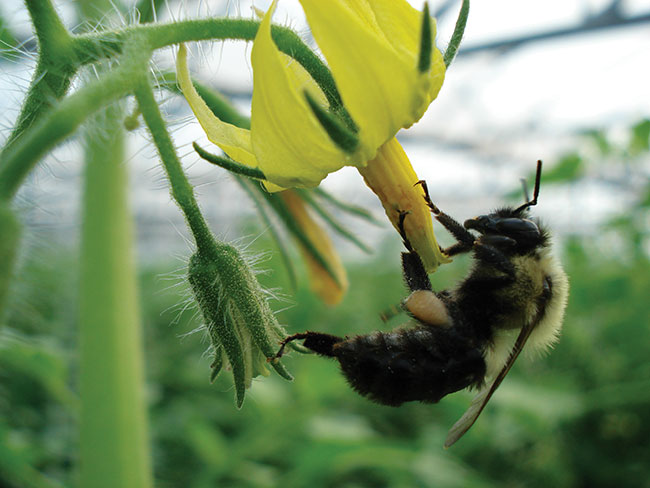
an image of a bee pollinating a tomato
Why Greenhouse Plants Need Help Pollinating
Outdoors, wind shakes flowers and insects carry pollen between blooms. A closed greenhouse removes both. South Dakota State University Extension notes that field tomatoes rely on natural wind to vibrate flowers, but “this is not generally true in the high tunnel because there is not sufficient natural wind.” Without intervention, blossoms drop and fruit never sets.
Pollination is the transfer of pollen from the male part of a flower (the stamen) to the female part (the pistil). That transfer triggers fertilization, which lets the plant form seeds and fruit. Some crops are self-fertile and only need their pollen jostled loose. Others need pollen carried from flower to flower. Either way, the still air inside a greenhouse stalls the process.
According to South Dakota State University Extension, enclosed structures lack the wind that pollinates field crops, so growers must “tap on the support strings to vibrate the flower cluster every other day or at least three days per week.” Skipping this step is the most common cause of blossom drop and empty trusses in greenhouse tomatoes.
Low humidity and poor air circulation make matters worse. Pollen that is too dry or too damp will not stick to the stigma, so the same conditions that protect your plants from weather can quietly stall fruit set. If your air runs dry, our guide on how to raise greenhouse moisture covers simple fixes that also improve pollen transfer.
Natural Pollination
Some pollinators still find their way in. Native bees, flies, and beetles drift through open vents and gaps on warm days, and you can encourage them with nectar plants and nesting sites. This costs nothing, but it rarely covers a full crop on its own, so treat it as a supplement to hand or bee pollination rather than your only plan.
Plant Nectar-Rich Flowers
Grow pollen and nectar plants inside and around the greenhouse to feed visiting insects. Good options include:
Leave areas of undisturbed soil and stems for ground-nesting bees.
Set out bundles of hollow sticks or reeds for stem-nesters.
Mount solitary bee houses on greenhouse walls or a nearby structure.
Open Vents and Doors
Open vents and doors on warm, sunny days so pollinators can enter.
Add screens at large openings to keep pest insects out.
Even a pollinator-friendly setup leaves gaps, especially in cool weather or a tightly sealed structure. Most growers still need an assisted method to finish the job and guarantee a crop.
Assisted Pollination
Assisted pollination puts you in control of fruit set instead of leaving it to chance. The three reliable approaches are hand pollination with a tool, a managed bumblebee hive, and mechanical devices that shake pollen loose. Ohio State Extension reports that for tomatoes, “pollination by bees results in higher fruit set, yield, and weight than all other methods,” which is why commercial growers lean on bumblebees at scale. Reliable pollination is also what makes a crop worth selling, so if you are weighing turning a greenhouse into income, a dependable bee or wand routine is the difference between a few stray fruits and a harvest you can take to market.
Ohio State University Extension reports that bumble bees grasp a flower’s anthers and “vibrate rigorously to dislodge the pollen,” a technique called buzz pollination that tomatoes specifically need. Around 95% of commercially managed bumble bee colonies are used in tomato greenhouses, making bees the dominant method once an operation grows past hand-pollination scale.
1. Hand Pollination with Tools
Also called manual pollination, this means transferring pollen from male to female flower parts by hand. For tomatoes, peppers, and other self-fertile crops, you simply vibrate each flower cluster so the pollen falls onto its own stigma. For cucumbers and squash, which have separate male and female blooms, you move pollen between them.
The basic process:
Identify the flowers. Self-fertile crops like tomatoes carry both parts in one bloom; vining crops have separate male flowers (with a stamen) and female flowers (with a pistil and a tiny fruit behind the petals).
Collect or release pollen. Tap a male flower over a spoon or paper plate, or for tomatoes, vibrate the cluster to shake pollen loose.
Apply it to the stigma. Brush or dab pollen onto the center of each open female flower.
Common hand tools include a feather or artist’s paintbrush, a cotton swab, a plastic spoon, and a battery-powered electric vibrating wand. The wand is the fastest for tomatoes: you touch it to the stem of each flower cluster for a couple of seconds and the vibration does the work. Hand pollination is highly effective but you have to repeat it on every new bloom, which gets slow in a large house.
2. Bumblebee Hives
Bumblebees are the most efficient greenhouse pollinators, and they work where honeybees struggle. They fly in cooler temperatures, stay focused on indoor flowers instead of wandering outside, and buzz-pollinate by vibrating each bloom thoroughly. A managed hive frees you from daily flower-by-flower work.
Key advantages:
Active from early spring through late fall.
Fly in cooler, dimmer conditions than honeybees.
Buzz pollination shakes pollen loose more completely than a brush.
Higher and more consistent yields than hand pollination.
To get good results:
Choose a commercial hive sized for your growing area; oversupplying bees can damage flowers, so match colony count to square footage.
Position hives one to three feet off the ground in a central spot, shaded from direct sun, rain, and any chemical sprays.
Remove hives before applying pesticides and when blooming slows, and keep nectar plants like clover or asters nearby.
3. Mechanical and Pneumatic Tools
Battery-powered tools dislodge and spread pollen across an enclosed space faster than a brush. They suit medium-to-large grows where hand pollination would eat your whole morning, so they pay off most in a larger greenhouse packed with rows. The trade-off is upfront cost and, for blowers, slightly lower fruit quality than direct vibration.
Popular options:
Electric toothbrushes or facial massagers: the vibrating head releases pollen when touched to the flower stem.
Battery fans or blowers: push pollen between rows; SDSU Extension notes blowers give lower fruit quality and yield than vibrating each cluster.
Feather or soft-bristle dusters: sweep pollen gently onto stigmas across many flowers.
Whatever tool you choose, timing matters. Pollinate in the mid-to-late morning when humidity is lowest and pollen sheds freely, repeat every other day or daily during peak bloom, and shift peppers toward midday to avoid blossom drop.
a butterfly on a yellow flower
Step-by-Step Pollination
Once you have chosen a method, this daily routine keeps fruit setting through the whole flowering period. The work itself takes only a few minutes per pass, but consistency is what separates a heavy harvest from a sparse one. Walk the rows at the same time each day so no open bloom gets missed.
1. Prepare the Greenhouse
For bees, set up hives or nesting boxes and a clean water source.
Lay out collection tools or charge your electric wand if pollinating by hand.
Place flowering plants near doors and vents to draw in any natural pollinators.
Prune excess foliage that blocks access to the flowers.
2. Monitor Flowering and Pollen Release
Check each plant daily for newly opened flowers.
For tomatoes, note when blooms are fully open and shedding pollen (usually mid-morning).
3. Pollinate Open Flowers
Locate the pistil in the center of each open bloom.
Vibrate, brush, or tap pollen onto the stigma of every open flower using your chosen method.
4. Record Progress
Note which plants you pollinated each day so nothing is skipped on the next pass.
5. Repeat on Schedule
Vibrate-pollinate crops respond best to every-other-day passes; brush-pollinated vining crops need each new female flower hit the day it opens.
6. Provide Aftercare
Keep bees fed and refill nectar plants for natural pollinators.
Water and weed regularly so pollinated flowers can set healthy fruit.
A small fruit swelling behind a wilting flower a week later tells you the pollination took. If you want a planting list matched to greenhouse conditions, see our guide on what to grow first in a greenhouse.
Conditions for Successful Pollination
Even perfect technique fails in the wrong climate. Pollen needs a specific window of temperature and humidity to shed and stick. Tomato pollen, for example, sets poorly above 90°F or in soggy air. Keep the greenhouse inside the ranges below and your hand, bee, or mechanical pollination will take far more reliably.
Factor
Ideal Pollination Range
Temperature
65°F to 85°F
Humidity
40% to 60%
Airflow
Gentle fan or vent movement, never strong wind
Light
Bright, sunny conditions
Track yields as you go. If fruit set drops, check these four factors first, then inspect your pollinators and method before assuming a pest or disease. Sustained, well-timed pollination across the season is what turns a greenhouse from a pretty structure into a productive one.
FAQs
Do all greenhouse plants need to be pollinated?
No. Leafy greens, herbs, and root crops are harvested before they fruit, so they do not need pollination at all. Self-fertile crops like tomatoes and peppers need only a vibration to shed their own pollen, while cucumbers, squash, and melons need pollen carried between separate male and female flowers.
Will a vibrating toothbrush actually work for tomatoes?
Yes. A battery toothbrush or small electric massager held to the stem of a flower cluster for a couple of seconds shakes pollen loose much like a bumblebee does. Pollinate every other day in mid-morning when humidity is lowest, and you will see strong fruit set without buying a dedicated pollination wand.
How are bumblebees better than honeybees in a greenhouse?
Bumblebees fly in cooler, dimmer conditions, stay focused on indoor flowers instead of leaving to forage outside, and perform buzz pollination by vibrating each bloom. That last trait matters for tomatoes, which only release pollen when shaken, so bumblebees suit enclosed crops far better than honeybees.
What time of day is best for greenhouse pollination?
Mid-to-late morning is ideal for most crops because humidity is at its lowest and pollen sheds freely from the anthers. Peppers do better closer to midday, which helps prevent blossom drop. Avoid late afternoon and evening, when damp air keeps pollen from releasing cleanly.
How does greenhouse size change the best pollination method?
In a compact greenhouse, hand pollination is quick and cheap because there are few plants to reach. In a bigger structure, an electric wand or a managed bumblebee hive saves hours, and controlling airflow becomes more important so pollen moves between widely spaced rows. A reliable routine is the difference between a few stray fruits and a full crop.
Ready to give your plants a controlled space to thrive? Browse our greenhouse kits to find a structure sized for your crops, then pair it with the pollination routine above for a full, reliable harvest.




Leave a comment